01
Page caching
The first request builds the page; subsequent requests receive static HTML from disk.
Visit the product website: djia-cache.com
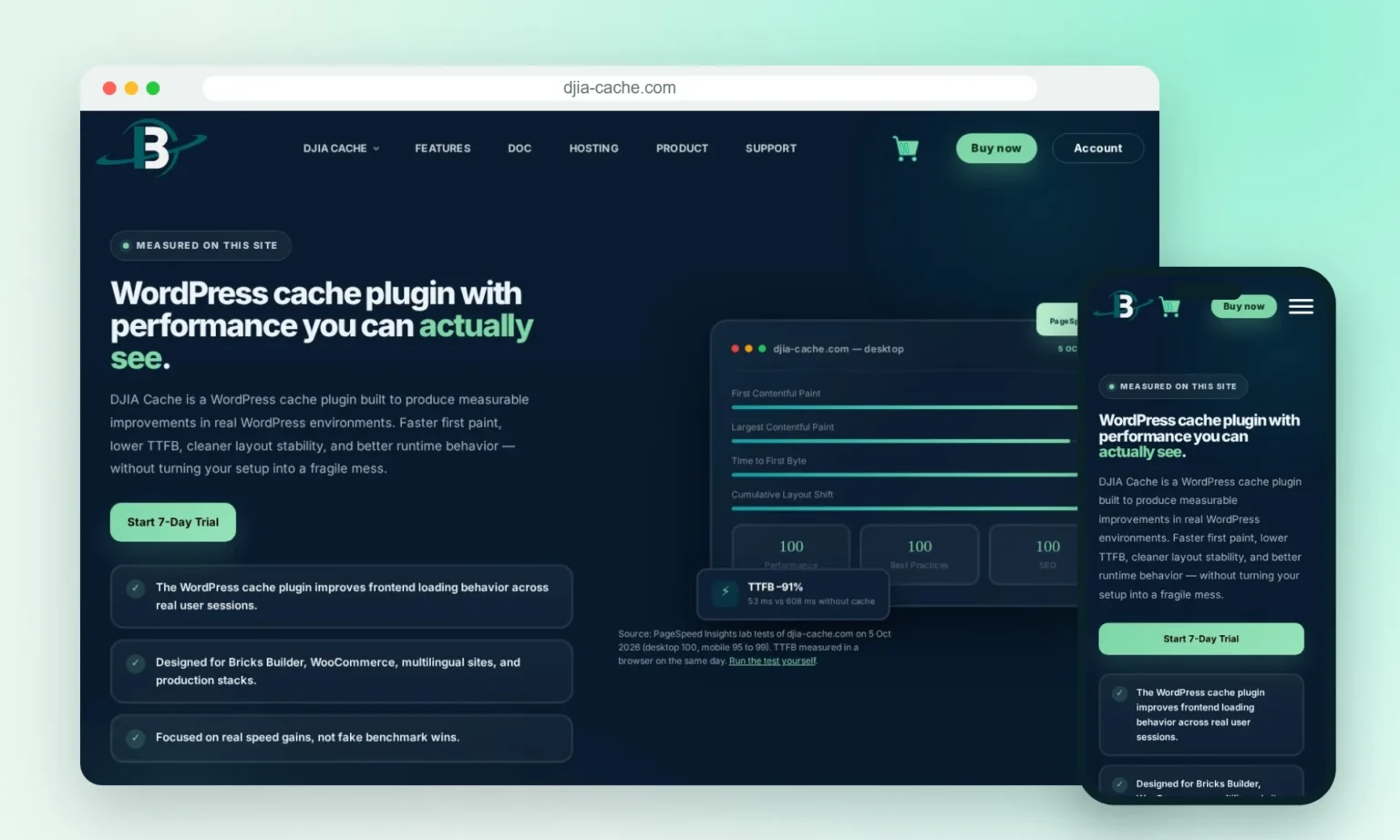
Laboratory PageSpeed Insights tests and browser TTFB measurements dated 5 October 2026, according to djia-cache.com. Your results depend on server, theme and plugins.
Fast, even when complex.
The first visit generates the page. Djia Cache saves it to disk so later visitors receive ready-made HTML instead of rerunning PHP, database queries and plugins.
Publishing or editing content clears only affected cache entries. Background warming rebuilds them, avoiding a slow first request for visitors.
One purpose, carefully implemented.
Code-changing options can be disabled individually. Disabling the plugin removes saved files and restores normal page generation without changing content.
Features are split into modules. Enable what your website needs and leave everything else disabled.
The first request builds the page; subsequent requests receive static HTML from disk.
Signed-in pages use separate cache groups; mobile and desktop caches are also separated.
Cart, checkout and account pages bypass caching, with store rules included by default.
Publishing clears only related entries, then rebuilds them in the background.
Identifies the probable LCP element, preloads it in the head and clears page cache when saved in the builder.
Minification, compression and deferred scripts, including Delay JS for nonessential JavaScript until interaction.
Critical CSS, lazy loading, LCP preloading and font settings, each with its own switch.
Each language receives a separate cache key. Register language and currency cookies as dynamic.
Browser cache headers and CDN URL rewriting, supporting Cloudflare and other networks.
Four steps that run automatically after configuration.
Djia Cache examines plugins, theme, hosting and traffic, then selects a caching strategy.
A store with customer accounts requires different rules from a simple blog.
Each page is generated once and saved to disk as static HTML.
Subsequent visitors receive that file without PHP execution or database queries.
Publishing a post or product clears only cache entries containing it.
The warming module rebuilds entries in the background so visitors do not wait.
Serving the same file supports consistent results across tests and real visits.
The Bricks module records its chosen LCP element in an HTML comment so you can verify the decision.
Djia Cache works with any theme because it stores the HTML the theme already generates.
All plans include the same features and differ only in website count and licence duration. The seven-day trial includes all features without a card. Each domain occupies a slot; a separate staging domain also uses a slot. Manage and release slots in the licence portal. Prices in dollars according to djia-cache.com/pricing.
Yes, for page caching, because it stores the HTML your theme produces. Test CSS and JavaScript optimization options on your website and disable individual options if necessary.
Mainly when visitors are far from the server. A CDN shortens delivery distance, while caching reduces page-generation work.
Only affected cache entries are cleared, and the warming module rebuilds them in the background.
Yes, if the host provides an edge cache. Enable fewer modules and let the host handle functions it already provides.
No. It operates on the public website. Saving a page in the builder clears its affected cache entries in the background.
Saved files are removed and pages generate as before. Website content is unchanged.
Yes. The trial runs for seven days on your website, with all features and no card required.